
Solving The Three Body AI Problem Using Current Tools Rather Than Future Machines
$10M of Startup money to build a fanciful space-based server farm. Yet China are already building an AI constellation with current designs

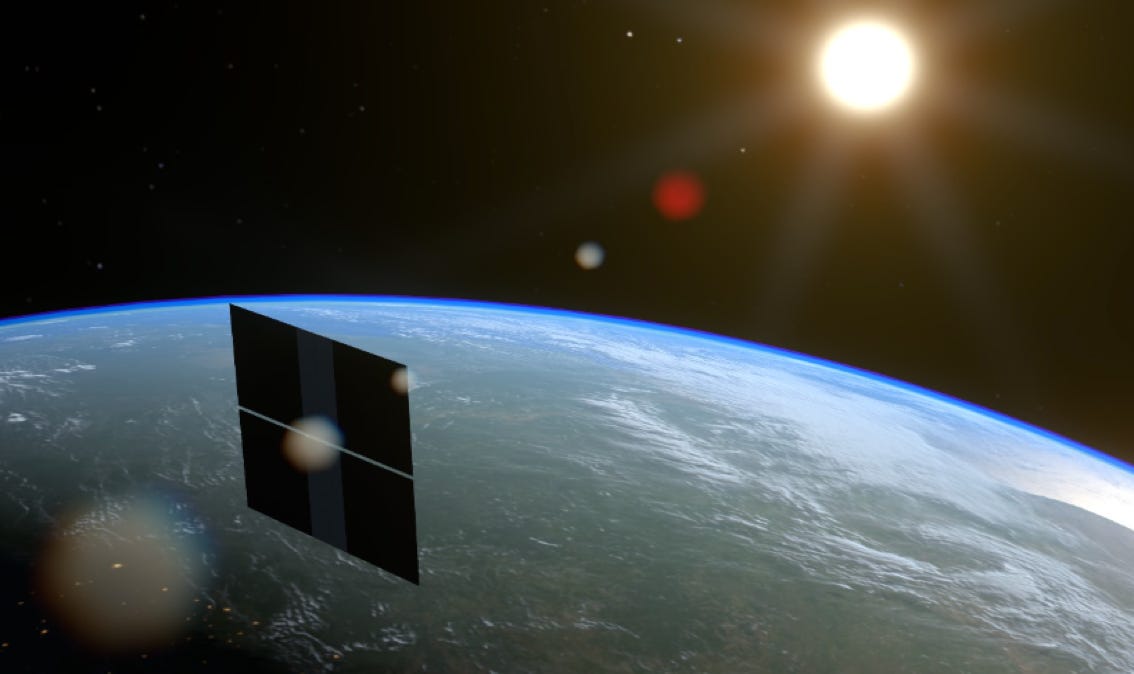
I was skimming through LinkedIn and since I have a lot of contacts in the space industry a post popped up about doing large compute in space with a company called Starcloud. It just means running computers in orbit using solar power and taking advantage of cooling gradients that exist when you aren’t facing the sun. The servers would be in bespoke satellites with huge solar arrays (4km x 4km) and be able transmit data back to Earth.
The idea is grounded in a a feature of the space environment discussed in their white paper:
For certain orbits, polar sun-synchronous ones in particular, you have one side of the spacecraft pointing at the sun continuously (or almost continuously) and you have the other pointed out to space.
With some thermal engineering you often get one side of the spacecraft at a hundred degrees celsius on the sun side and minus hundred plus on the other. In Kelvin terms it can be 370K or more compared to 170K to even 100K on the other.
Space-based large scale computing itself (i.e. servers and racks) has been tried in the last decade. One example is on the ISS where they had a program called Spacebased Computer. They tried two rack configurations to see what having typical solid-state drives would be like. The ISS itself obviously has had a computer network for a long time (as the article describes) but this experiment was to use server racks specifically, and ones that were identical to what we see on Earth. In recent years more experiments have been performed.
The upshot was that yes space-based servers could be done. There were issues with radiation, but cooling and power may be easy to do for the very reasons discussed. Hence the programs to have solar panelled craft and specific orbits.
Starcloud got $10M in a seed round so there are some serious backers (or maybe just a bunch of gamblers?)
My first thought was “Why are we talking about it in white papers when you could be throwing something up there now?”
The reason this comes to mind is because in the Linked In article and their paper it even talked about the reduced launch cost and the greater flexibility with companies such as SpaceX driving this trend.
But the thing about SpaceX is that they themselves flew a lot of technology on their own satellites to rapidly develop ideas. The ion thrusters on Starlink started were trialled with other tech on the Microsat 2a and 2b missions.
Yes, SpaceX have the money, but so do other companies and SpaceX can do rideshare. Or you may go with a Chinese company and do it (national security and IP issues aside here).
And that’s when I also came across an article that the Chinese have already started doing something similar:
China creates an AI supercomputer in space
By using a constellation they’ve already got a working test in space, much like SpaceX would have done (or maybe they are already thinking of doing this?).
Rather than wait for a 4km x 4km solar array and a “stem and leaf” server docking system which all sound great on paper, the Chinese are networking satellites together using constellation formations that have been shown to work. Where has this been shown? At large scale there’s Starlink, which it appears the Chinese have copied somewhat for their Qianfan (Thousand Sails) constellation.
Right now we have the start of a working model that money has already been poured into.
So the question is why couldn’t they have just leveraged SpaceX’s satellite bus format and changed the payload?
Much in the same way that the same satellites could used to monitor debris.
I understand the lure of the new and fanciful and it will be great to see a 4km x 4km solar array in action (debris problems aside). But is there really going to get into its stride before the Chinese constellation is up there crunching numbers in anger?