
Ion thrusters and Ionic devices - Part 1
A series of posts about the possibilities of ion thrusters and ionic devices

In these posts I am interested in discussing how these two technologies could be linked to create a plasma devices that work on the ground or in the air without using complicated equipment. And how it may lead to interesting inventions or just interesting ideas.
Definitions
An ion thruster is a device more or less used in space. It involves creating a plasma from gas such as xenon or argon in low pressure or vacuum conditions. The ions are extracted using electric fields and then accelerated either using the same electric field configuration or by an extra applied field. When the ions leave another smaller plasma device is used to shoot electrons into the ion beam to neutralise it otherwise the growing ion cloud would quickly prevent other ions being emitted.
This is a simplification of the nuances of these devices but in principle it can be summarised using the following phrase: Push, Zap, Suck, Blow.
This is analogous to Suck, Squeeze, Bang, Blow which is how an axial jet engine works.
Ion thrusters come in different types: gridded, Hall-effect, FEEP but the idea is basically the same. Ions are created, accelerated and neutralised.
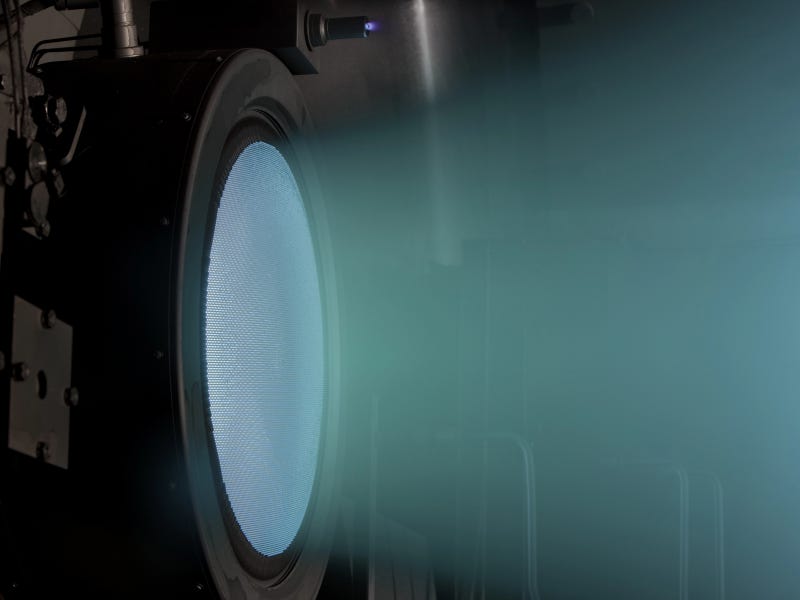
Image from NASA/Space.com
An ionic device is another type of plasma device but this tends to work in atmosphere. It usually involves creating an arc that accelerates ions towards a wire or a conducting ring. In the process, the ions of the arc drag air particles with them creating a sort of wind. Work is being done to try and improve the amount of thrust that these devices can make.
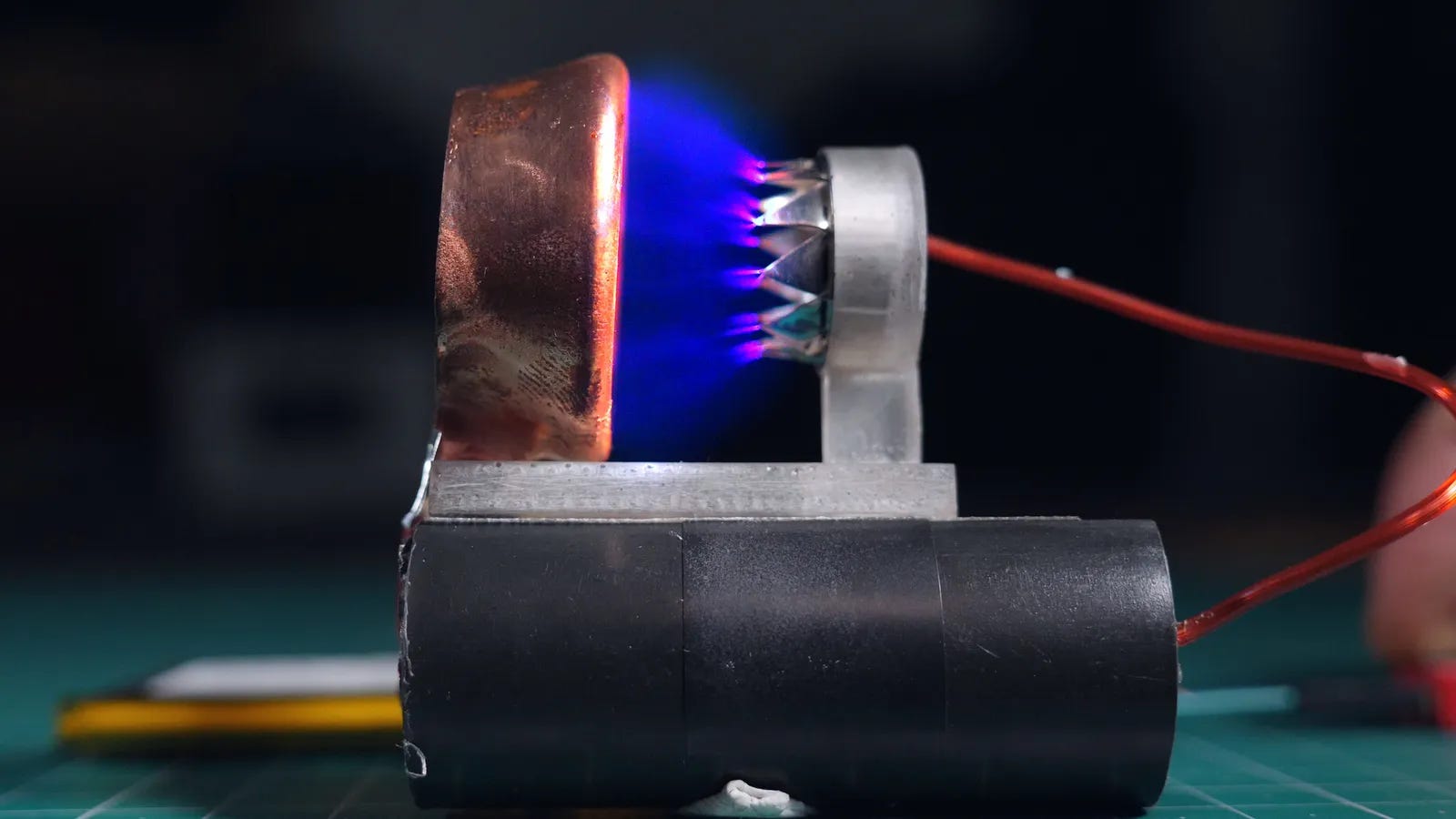
Image from Printables
Typical ion thruster characteristics
Ion thrusters have been designed specifically to meet certain criteria for space missions. These are:
Long duration lifetimes - > 10,000 hrs operation
High specific impulse - this is a measure of how effective the thrust to fuel used ratio is
Steady output - ranging from sub mN to 125 mN and above
Note that the thrust of such devices is in the mN (milliNewton) range. 10 mN is about the same force produced as holding a piece of writing paper (A4, Letter). These are not the collosal engines used to put satellites into space. Or to throttle back on a first stage booster to be caught by a launch tower.
These devices produce very small amounts of thrust but importantly they can be run from months, even years, all the while accelerating the spacecraft. The result is that a spacecraft can be accelerated to very high speeds such as Deep Space 1.
In general these days they can be used for orbit raising, station keeping and also uncomplicated orbital insertion. Typically orbital insertion (where a satellite locks into orbit around a planet, moon or asteroid) can be tricky as you have to match orbit variations. If you use a “bang-bang” approach with a chemical or cold gas device you sometimes don’t have the precision to match non-nominal orbital variations, like what happens in the case of an asteroid. However because an ion thruster varies the thrust in small increments, often a satellite will just “drift” into the correct orbit which is what happened with the DAWN mission to Vesta.
The physics behind ion thrusters has been studied for at least sixty years by this point and advancements in thrust or lifetime as well as simplification and commoditisation has occurred at the same time.
In principle, the manipulation of geometries, electric fields, chamber materials and gas types can give rise to different ion creation scenarios. At the edges though there are techniques that involve acoustic interference effects and dispersion/feedback processes that often mean you can’t just keep cranking more power into the devices.
However some of these inputs could be studied in line with ionic devices.
Typical ionic thruster characteristics
Interest in ionic thrusters and ionic cells has only recently become more widespread very often driven by social media channels and individual engineers working with different designs. However insitutions have played a role, for example MIT studying the feasability of having a plane with no propellers or moving parts. Original designs go back to the 1990s.
Ionic thrusters main property is producing a flow speed of a few m/s, although there has been a cross-over to ion thrusters in the sense that a 3D printed ion emitter was flown in space
In general what we see with ionic thrusters is akin to making powerful fans with no propellers or other moving parts. And this is actually useful as part of this airflow is a plasma.
Something to think about…
To end this Part 1, the idea then is can you take the plasma generation ionic thruster and then do something with the plasma it creates using ion thruster techniques?
Can the plasma density and strength be increased and can this be used to create even more thrust from the device?