
Fortnight 200 m Conjunction Report - Mar 20th to April 2nd 2025
There were 111 and 126 conjunctions under 200 m for the last two weeks.

Note: The conjunction report will be done bi-weekly now
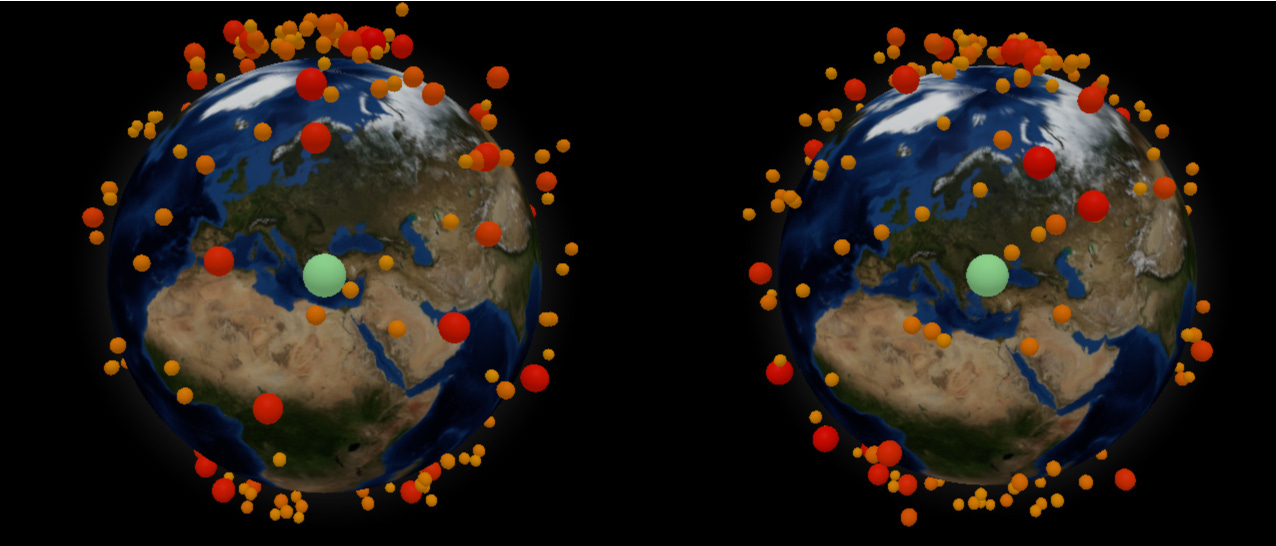
Summary
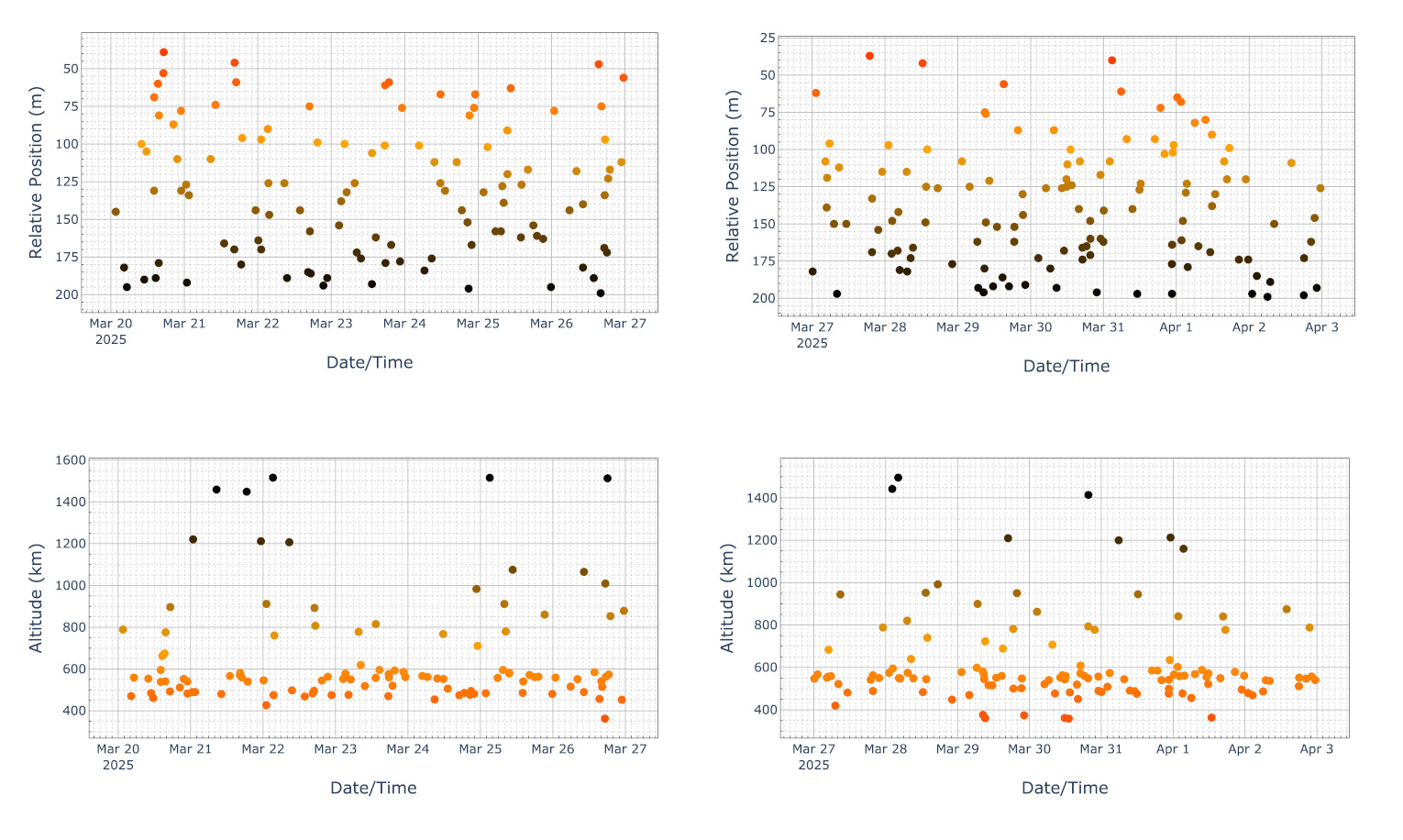
There are 111 conjunctions under 200 m for the week 2025-03-20 to 2025-03-26 and 126 conjunctions under 200 m for the week 2025-03-27 to 2025-04-02
The majority of conjunctions occur at altitudes less than 600 km
The closest conjunctions each week were:
39 m between Tianqi 31 (ID: 61197) and Fengyun 1C debris (ID: 37682) at a geodetic altitude of 896 km on 2025-03-20
37 m between Starlink-4615 (ID: 53620) and Object AB (ID: 57191) at a geodetic altitude of 542 km on 2025-03-27
At any point you can get this data yourself by going to https://overhead.docksat.space and signing up for a free account using the Log In button ( then Create Account ). If you want to download the complete history and other data you can also sign up for a subscription
For context, all of these objects recorded by the Overhead app are moving at velocities of 5 km/s upwards so a conjunction of 50 m represents a timeframe of 10 ms. Relative velocities can be over 10 km/s. There would not be time to make a significant manoeuvre, if at all.
Total Counts
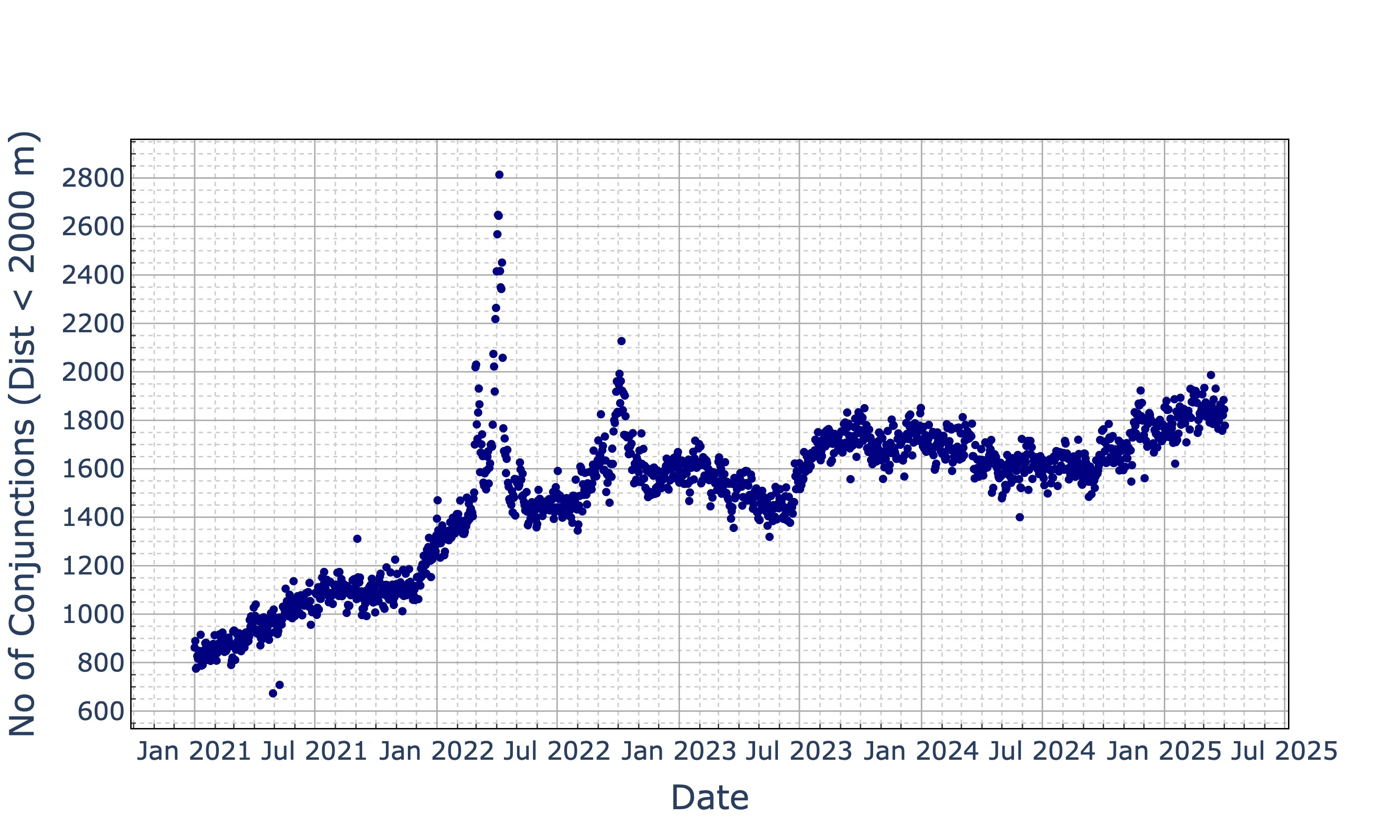
The total conjunction counts produced by the Overhead web app relating to Payload-To-Other conjunctions excluding payloads to payloads in their own family (ONEWEB to ONEWEB for example) is shown below.
The relative conjunction distances and altitudes where they occur (note distance axis is reversed) are shown below:
Data for the graphs can be found at:
Overhead Weekly Report - 2025-03-26
Overhead Weekly Report - 2025-04-02
Closest Conjunctions
The closest conjunction this week were:
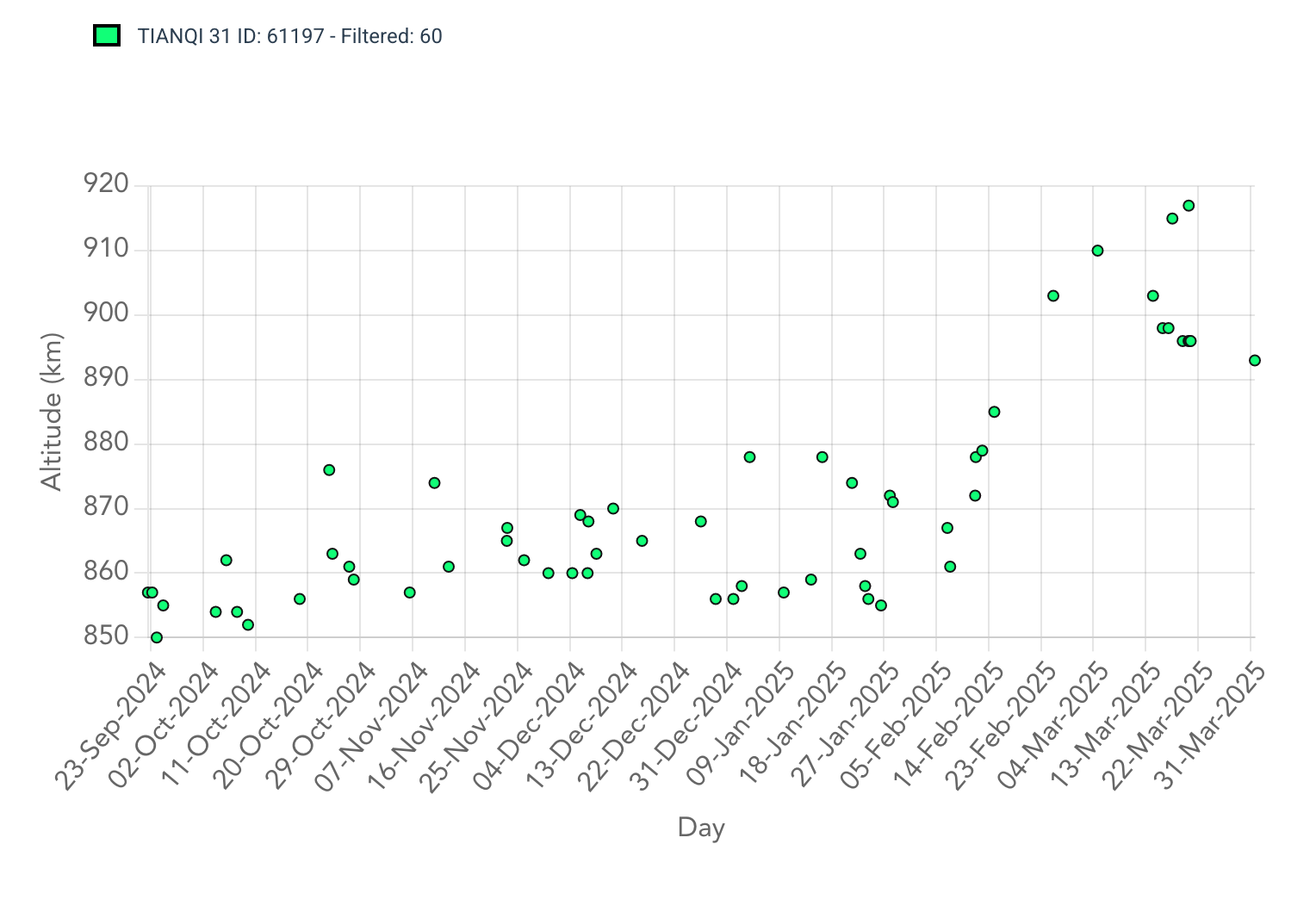
39 m between Tianqi 31 (ID: 61197) and Fengyun 1C debris (ID: 37682) on 2025-03-20 at 17:16:34.71 UTC at a geodetic altitude of 896 km, position 43.7° N, 28.3° E
37 m between Starlink-4615 (ID: 53620) and Object AB (ID: 57191) on 2025-03-27 at 18:57:59.43 UTC at a geodetic altitude of 542 km, position 37.3° N, 26.8° E
Tianqi 31 is a Chinese satellite launched in September 2024 that contains a LoRa payload. The payload transmits data periodically. LoRa is an important technology for the Internet of Things (IoT) but more specifically it is a very good long range low data low power persistence technology. Sending LoRa messages via satellites often extends scope of LoRa networks which themselves can work over 10s of kilometers on the ground.
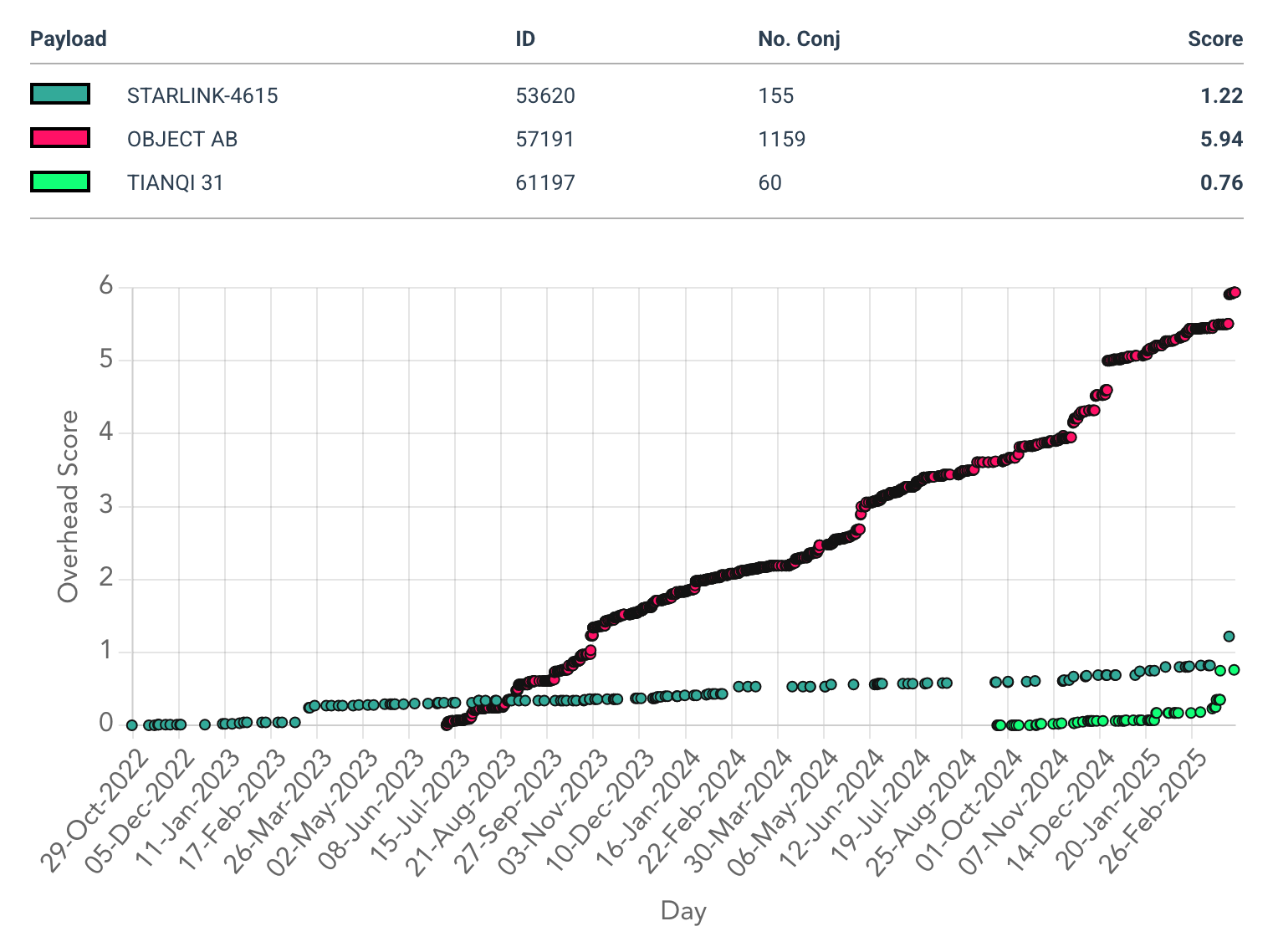
Starlink 4615 is a 3-year old Starlink satellite flying in the primary altitude region around 550 km.
Object AB (ID: 57191) was launched from Vostochny Cosmodrome (VOSTO) in June 2023. As it is tracked but not categorised not much more can be detailed about it.
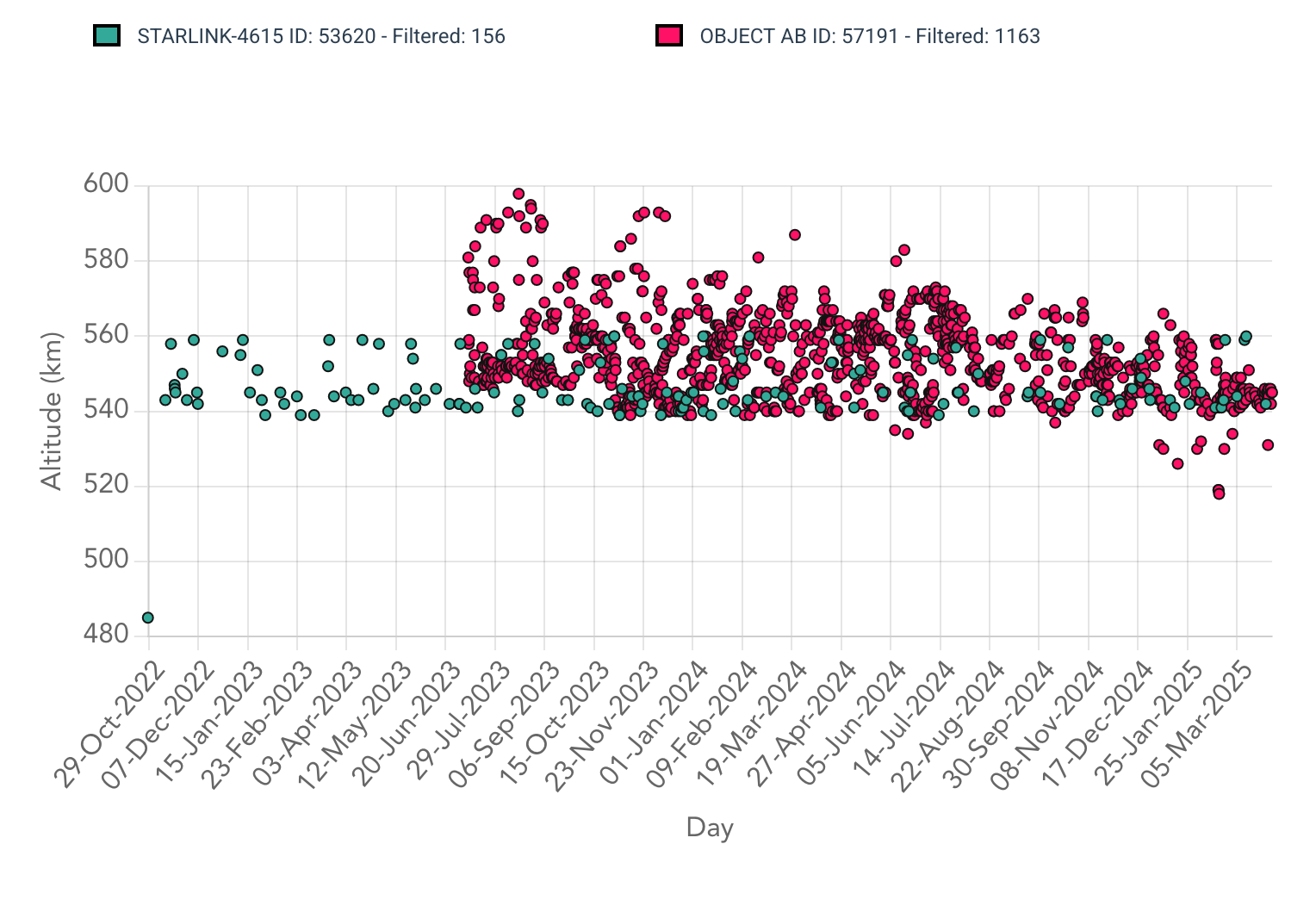
Satellite data is shown below (Note each dot is a different interaction with a different satellite).
Altitude:
Overhead:
Payload family percentages (i.e. what payload family makes up the most conjunctions):
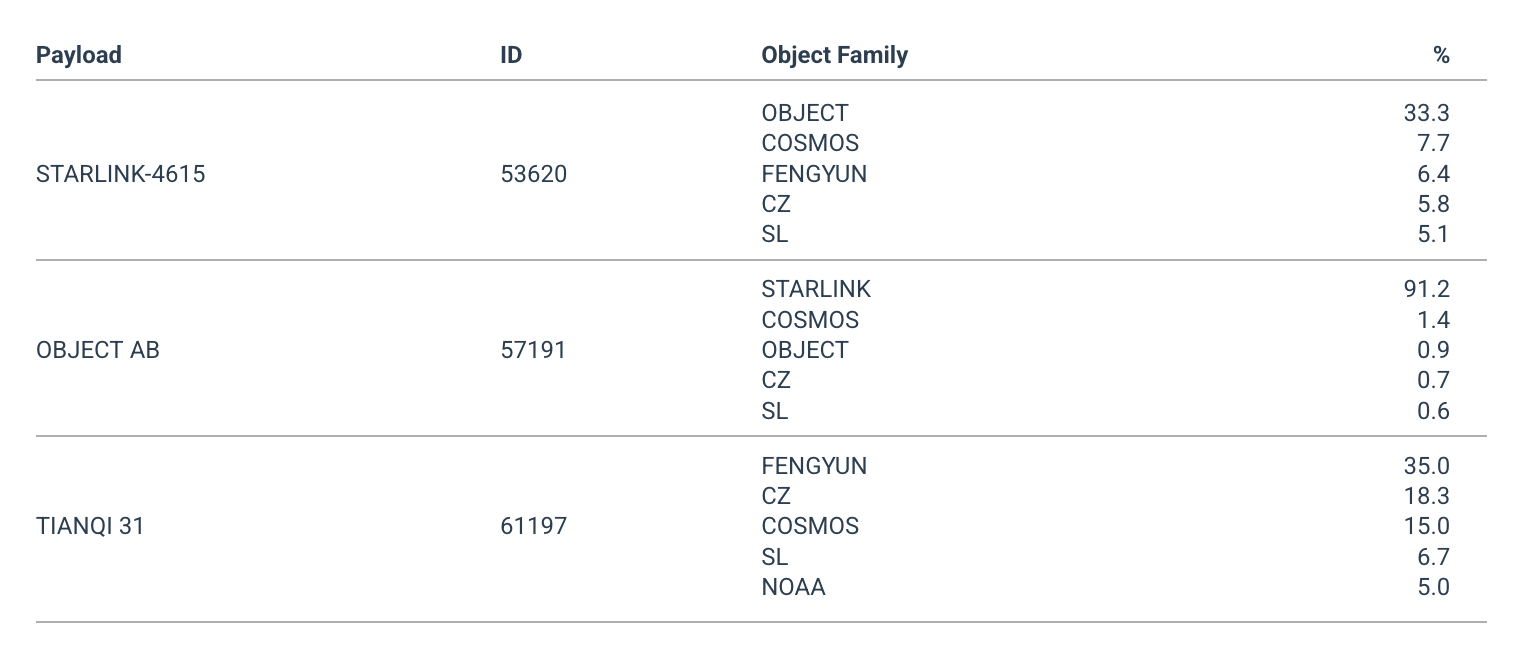
Object AB’s conjunctions are overwhelmingly Starlink interactions. Tianqi 31, flying at a higher altitude is seeing lots of Fengyun debris (mostly Fengyun 1C).
Summary (again)
There are 111 conjunctions under 200 m for the week 2025-03-20 to 2025-03-26 and 126 conjunctions under 200 m for the week 2025-03-27 to 2025-04-02
The majority of conjunctions occur at altitudes less than 600 km
The closest conjunctions each week were:
39 m between Tianqi 31 (ID: 61197) and Fengyun 1C debris (ID: 37682) at a geodetic altitude of 896 km on 2025-03-20
37 m between Starlink-4615 (ID: 53620) and Object AB (ID: 57191) at a geodetic altitude of 542 km on 2025-03-27
As described in What is Overhead? these conjunctions are calculated from projected positions for a 24 hour period using satellite TLE data from Space Track.org where data is updated each day. Conjunctions are filtered to leave Payload-to-Other types, excluding payload families to each other. Data starts from Jan 1st 2021 until now. Take from that what you will and use at your discretion.
